Over 100 years ago, the Hilltribe peoples migrated south from China into Burma, Laos, Vietnam, and Thailand. The six major tribes are the Karen, Hmong, Yao, Akha, Lisu, and the Lahu. These tribes are typically sustained by farming, and all of them tend to migrate whenever they feel that the soil at their present location is becoming depleted. Each tribe is distinct with its own culture, religion, language, art, and dress. With Thailand undergoing rapid modern development, it is difficult yet to say whether these tribes will continue in there traditional ways of life, or whether they will eventually be absorbed into the surrounding, and ever more-encroaching, Thai society. We will visit three tribes - the Padong (Karen sub-group), the Lahu Shi Balah (or Yellow Lahu) and the Akha.
Padong (Karen sub-group)
 The most populous minority group here; there are in fact more Karen than all the other ethnic minorities in northern Thailand combined. They have also lived in this area far longer than the other mountain people. Over 200 years is probable, and perhaps much longer than that. Neighbouring Myanmar is home to over four million Karen. They inhabit many areas of western and northern Thailand, and can be divided into several sub- groups, the most numerous in Thailand being the Sgaw Karen, and the Pwo Karen. The Padong, the famous "long-neck" people whose women traditionally wear many tight bronze rings around their necks, are another of the many subgroups. The Karen typically live at low altitudes and many have now integrated into mainstream Thai culture, and are known to be an exceptionally warm, friendly, and gentle people.
Lahu
 The Lahu ethnic group originated is south west China, and subsequently migrated into Thailand from northern Myanmar, Most of their settlements are concentrated close to the Burmese border in Chiang Rai, northern Chiang Mai, and Mae Hong Son province. There are four sub-groups of Lahu here - Black, Yellow, Red, and She-leh. The Black Lahu are the most reserved, but wear the most distinctive costumes. Among the other Lahu tribes, the Thai shirt and sarong have replaced their traditional costume. Lahu men wear a plain black shirt and baggy black trousers. Lahu villages are often at higher altitudes. The Thais call the Lahu tribe Musur, which means "hunters." Indeed, they were largely a hunting community until a lack of game and primary forest forced them into a more agricultural means of existence.
Akha
 The Akha people are rightly famous for their very exotic and beautiful costumes, and can be seen in many towns in Thailand selling their unique handicrafts. Akha people are usually of small stature, with dark skin and fine, delicate features. Despite their typical poverty, they have a resolute spirit and a great sense of humour. Quick to laugh and joke, they are delightful people to stay with or visit, and are very generous with whatever they may have. The Akha originate in Tibet and southern China, and have only recently entered Thailand, the first immigrants arriving around 1905. They are found only in the far north of Thailand, mainly in Chiang Rai and Chiang Mai provinces.
Padong (Karen sub-group)
The most populous minority group here; there are in fact more Karen than all the other ethnic minorities in northern Thailand combined. They have also lived in this area far longer than the other mountain people. Over 200 years is probable, and perhaps much longer than that. Neighbouring Myanmar is home to over four million Karen. They inhabit many areas of western and northern Thailand, and can be divided into several sub- groups, the most numerous in Thailand being the Sgaw Karen, and the Pwo Karen. The Padong, the famous "long-neck" people whose women traditionally wear many tight bronze rings around their necks, are another of the many subgroups. The Karen typically live at low altitudes and many have now integrated into mainstream Thai culture, and are known to be an exceptionally warm, friendly, and gentle people.Lahu
The Lahu ethnic group originated is south west China, and subsequently migrated into Thailand from northern Myanmar, Most of their settlements are concentrated close to the Burmese border in Chiang Rai, northern Chiang Mai, and Mae Hong Son province. There are four sub-groups of Lahu here - Black, Yellow, Red, and She-leh. The Black Lahu are the most reserved, but wear the most distinctive costumes. Among the other Lahu tribes, the Thai shirt and sarong have replaced their traditional costume. Lahu men wear a plain black shirt and baggy black trousers. Lahu villages are often at higher altitudes. The Thais call the Lahu tribe Musur, which means "hunters." Indeed, they were largely a hunting community until a lack of game and primary forest forced them into a more agricultural means of existence.Akha
The Akha people are rightly famous for their very exotic and beautiful costumes, and can be seen in many towns in Thailand selling their unique handicrafts. Akha people are usually of small stature, with dark skin and fine, delicate features. Despite their typical poverty, they have a resolute spirit and a great sense of humour. Quick to laugh and joke, they are delightful people to stay with or visit, and are very generous with whatever they may have. The Akha originate in Tibet and southern China, and have only recently entered Thailand, the first immigrants arriving around 1905. They are found only in the far north of Thailand, mainly in Chiang Rai and Chiang Mai provinces.HILLTRIBE VISITOR ETIQUETTE
It is considered kind, but not necessary, to give gifts to the people you visit. Some suggestions are sweets, balloons and other inexpensive toys, sewing supplies and foreign coins. Follow the advice of your guide and don't hesitate to ask questions. Respect the fact that you are a guest visiting the homes and villages of these people. Showing them that you are genuinely interested in them through your friendliness, sincerity and goodwill is a precious gift to offer.
Located north of Chiang Rai, Mai Sai is the most northern town in Thailand and directly on the Thai-Myanmar border. As this is one of the few active crossings between Thailand and Myanmar, Mai Sai has a ‘border town’ feel about it – plenty of coming and going and plenty of activity. The main street acts as a night market but most stalls close before it gets dark. The town has an excellent opium museum at Sop Ruak and is famous for its gem market where you can find precious stones such as rubies, emeralds and jade which are all mined in Myanmar (Burma). There’s a parallel market on the Burmese side of the border where gems and a host of other goods (mainly from China) are sold. A particular favourite is Chinese Champagne – huge magnums of the stuff come in at only a couple of dollars! Foreigners are allowed to go into Myanmar through Thakileik and can reach as far as Kentung.
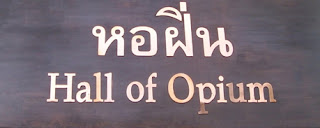 Thailand's new $10m opium museum is a brave attempt to uncover the mysteries of a poppy that has conquered the world. Located near Chiang Rai in the fabled Golden Triangle, a remote and lawless region of South-East Asia, the Hall of Opium will open to tourists later this year. The museum is located in the fabled Golden Triangle
Built by a royal foundation with Japanese assistance, the museum covers 6,000 square metres (60,000 square feet) on a grassy hillside overlooking the Mekong River.
Visitors enter the museum through a dark, misty tunnel that leads to the first exhibit - a neat flowerbed of red and white poppies. This is where the trail begins, with a plant whose white sap is extracted and boiled to make black opium. Opium has been used as a pain-killer for millennia, and was legally available in many countries until the start of the 20th Century.
As the museum makes clear, the opium trade has long fuelled wars and revolutions, while generating huge profits for merchants and governments around the world. Among the most memorable exhibits is a mock-up of a British clipper ship used to carry opium from India to China, where it was exchanged for tea and other spices.This trade sparked resistance from China's ruling dynasty, which was rudely crushed by British forces in the Opium Wars of the 19th Century.
Opium poppies once grew in the lush fields around the "Hall of Opium", but have mostly been eradicated by decades of crop-substitution projects. Probably the most successful is run by the Mae Fa Luang Foundation, which also designed the museum. Around 10,000 villagers live on its 150 square kilometre (60 square mile) site.
The infamous Golden Triangle, where the borders of Thailand, Myanmar and Laos converge, is Chiang Rai province's most popular attraction, luring thousands of visitors annually. This notorious area, located approximately nine kilometres from the historic town of Chiang Saen, is bolstered by its history and the surrounding towns. It's riverfront position at the confluence of the Mekhong and Ruak rivers lends it a unique appeal.
Located near the Northern-most point of Thailand - The Golden Triangle was once the centre of all opium poppy growing in the country, and actually refers to a large area of the three bordering countries. However, the point of actual convergence of these borders is what most people now call the Golden Triangle. Here, the illicit crops have long since been replaced by the small tourist village of Sob Ruak, and today the roads are flanked by countless small restaurants and vendor's souvenir stalls along the banks of the Mekhong river.
Located near the Northern-most point of Thailand - The Golden Triangle was once the centre of all opium poppy growing in the country, and actually refers to a large area of the three bordering countries. However, the point of actual convergence of these borders is what most people now call the Golden Triangle. Here, the illicit crops have long since been replaced by the small tourist village of Sob Ruak, and today the roads are flanked by countless small restaurants and vendor's souvenir stalls along the banks of the Mekhong river.
Wat Phrathat Doi Suthep was commissioned by King Kuena, who ruled Chiang Mai from 1367 to 1388. According to legend, the temple was built after the monk Sumana presented King Kuena with a bone relic of the historical Buddha. The king searched far and wide for a suitable spot to build the temple, but none could be found. Finally, the king tied the relic to the back of an elephant and set it loose. For days the elephant stomped through the jungle, shadowed by the king's men, until it reached the mountaintop of Doi Suthep. Construction began in 1386 and was completed within a few years.
The temple of Wat Phra That Doi Suthep is one of the most important temples in Chiang Mai, as well as one of the most revered among all Thais. The temple is a major pilgrimage destinations during the important Buddhist holidays of Makha Buja and Visak. Its importance, as well as its location, owes much to the legend of its founding.
According to this legend, a Buddha relic, which some say glowed, magically replicated just before it was about to be enshrined in the big chedi at Wat Suan Dok. The "cloned" relic was placed on the back of a sacred white elephant, which was allowed to roam wherever it wanted. The elephant eventually climbed to the top of Suthep Mountain, trumpeted three times, turned around three times, knelt down and died. This was taken as a sign that this was the spot where the relic wanted to be, so King Ku Na built the original of the chedi on Doi Suthep at the end of 14th century. The temple's golden chedi, or pagoda, contains holy Buddha relics, and attracts Buddhist pilgrims from all over the world throughout the year.
The temple of Wat Phra That Doi Suthep is one of the most important temples in Chiang Mai, as well as one of the most revered among all Thais. The temple is a major pilgrimage destinations during the important Buddhist holidays of Makha Buja and Visak. Its importance, as well as its location, owes much to the legend of its founding.
According to this legend, a Buddha relic, which some say glowed, magically replicated just before it was about to be enshrined in the big chedi at Wat Suan Dok. The "cloned" relic was placed on the back of a sacred white elephant, which was allowed to roam wherever it wanted. The elephant eventually climbed to the top of Suthep Mountain, trumpeted three times, turned around three times, knelt down and died. This was taken as a sign that this was the spot where the relic wanted to be, so King Ku Na built the original of the chedi on Doi Suthep at the end of 14th century. The temple's golden chedi, or pagoda, contains holy Buddha relics, and attracts Buddhist pilgrims from all over the world throughout the year.
Subscribe to:
Posts (Atom)
